Loading...
Serving Fayetteville, AR and surrounding areas. (479) 485-4698
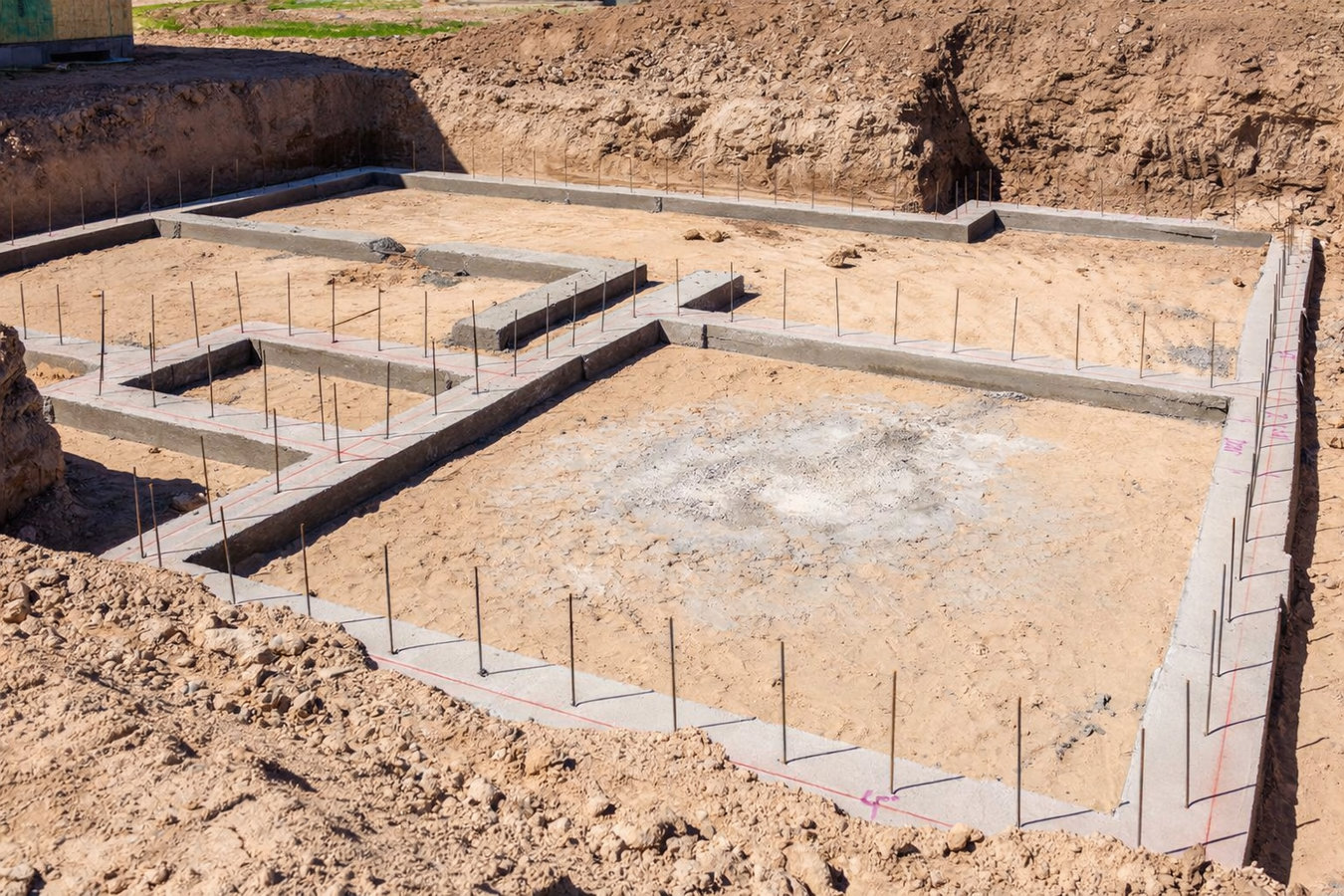
Your foundation supports everything above it - and mistakes here are never cheap to fix later. We install residential foundations in Fayetteville built for local soil, local rainfall, and city permit requirements.
Foundation installation in Fayetteville involves excavating the site to the required depth, compacting and preparing the subgrade, placing forms and steel reinforcement, and pouring concrete that becomes the permanent base your home sits on - most residential foundation installations take one to three weeks from first dig to framing-ready, depending on foundation type and lot conditions.
Fayetteville receives roughly 47 inches of rain per year, and much of Washington County sits on clay-heavy soil that swells when wet and shrinks when dry. A foundation installed without proper drainage planning and subgrade preparation in this environment will show the consequences within a few years - cracked walls, sticking doors, and water against the base of your home. If your project calls for a specific foundation type rather than a full ground-up installation, our slab foundation building page covers that scope in detail.
The City of Fayetteville Development Services requires a building permit for all new foundation work, and inspections happen at key stages before the concrete is placed. We handle the permit application as part of every job.
If doors or windows in your home have started sticking, jamming, or leaving visible gaps at the corners, the frame of your house may be shifting. This kind of movement often starts at the foundation - either because an existing one has cracked or settled unevenly, or because a new build needs a proper base before framing can begin. It is one of the first things homeowners notice, and blaming the door itself rarely solves the underlying problem.
Hairline cracks in drywall are common and usually harmless, but cracks that run diagonally from door corners, or cracks in a concrete floor wider than a pencil tip, often point to foundation movement. In Fayetteville, the clay-heavy soil in many neighborhoods expands and contracts with the seasons, and that movement shows up as cracking inside the home. New cracks appearing, or old ones getting wider, are worth having assessed.
Fayetteville's heavy spring rains can expose drainage problems quickly. Water sitting against foundation walls or collecting in a crawl space after a storm signals that the current foundation or grading is not doing its job. Left alone, that moisture works its way into the structure and causes damage that costs far more to fix than the original drainage problem would have.
If you have purchased land in Fayetteville and are planning to build, foundation installation is the first major step - everything else depends on it. The soil conditions, lot slope, and drainage patterns on your specific parcel determine what type of foundation makes sense and what site preparation is needed before the pour. Starting this conversation early keeps your whole build on schedule.
We install residential foundations across Fayetteville for new construction, additions, and replacement of failed existing foundations. Our scope includes site excavation, subgrade compaction and preparation, concrete forming, steel reinforcement placement, the pour, drainage planning integrated into the design, and final backfill after curing. Every installation goes through the City of Fayetteville's permit and inspection process - we handle the application and coordinate inspection scheduling so you do not have to manage the city paperwork. For projects that also need surface-level concrete work in a connected structure, we can coordinate with our concrete parking lot building team to sequence the work efficiently and avoid double site mobilization costs.
Foundation type depends on your lot and your project. A standard slab works well on prepared flat ground. A crawl space foundation raises the home off the ground and gives access to plumbing and wiring below - common in older Fayetteville homes and some hillside parcels. On sloped lots, a stepped or terraced foundation design is sometimes needed before any concrete can be placed level. We assess your specific parcel and recommend what makes sense - not a default template. For homeowners whose project also requires a standalone slab foundation building pour for a garage or addition, we scope that work together so it is sequenced alongside the main foundation project.
Best for vacant lots in Fayetteville where a full foundation is needed before framing can begin - slab, crawl space, or hillside design.
Suited for older Fayetteville homes where the existing crawl space or slab foundation has failed and needs to be removed and rebuilt correctly.
For parcels across Fayetteville's hillier terrain where standard slab installation is not practical without significant grading or stepped design.
Works for homeowners adding square footage - a room addition, guest suite, or workshop - that needs its own properly permitted concrete foundation.
Fayetteville's housing stock is unusually varied for a city its size. Older neighborhoods near the university - areas like Wilson Park, the Leverett Avenue corridor, and Dickson Street blocks - have homes built in the 1940s through 1960s on crawl space foundations that have spent decades dealing with Northwest Arkansas weather. Newer subdivisions on the south and west sides of the city have slab foundations built in the 1990s and 2000s, many of which are now reaching the age when concrete fatigue and drainage problems start to surface. The clay-heavy soil across much of Washington County is the underlying factor in both cases - it absorbs water and exerts pressure on any foundation that was not designed to account for it. We serve homeowners across the full range of these situations, and we also work regularly in Springdale where similar soil conditions and housing vintage create the same challenges.
Fayetteville's rapid growth over the past decade has pushed construction onto hillier parcels around the city's edges, which means more foundation projects that require non-standard grading and drainage solutions. Fayetteville also receives roughly 47 inches of rainfall annually - well above the national average - which makes waterproofing and drainage not optional extras but core parts of every installation. The freeze-thaw cycle between November and March adds another timing constraint: concrete poured when overnight temperatures are expected to drop below 40 degrees Fahrenheit needs protective measures to cure properly. We work in Fort Smith and across the wider region, but our depth of local Fayetteville experience is what allows us to estimate accurately and deliver predictably on foundation projects here. For soil-specific guidance relevant to this area, the Arkansas Geological Survey publishes data on Washington County's expansive clay conditions.
We visit your Fayetteville property to walk the lot, assess slope and drainage patterns, and ask about your project plans before giving any numbers. Site visits cost nothing and usually take 30 to 60 minutes. We do not quote foundation work over the phone - too much depends on your specific lot conditions.
Once you approve the written estimate, we apply for the City of Fayetteville building permit before any equipment arrives on site. Permit approval typically takes a few business days to two weeks. We handle the paperwork and will let you know when the permit is in hand and work can begin.
The crew excavates the foundation area, compacts the subgrade, adds gravel and drainage material, builds the forms, and places steel reinforcement. A city inspector reviews this work before the concrete is placed - that inspection is your independent check that everything is correct before it is permanently buried.
Concrete is placed in a single pour for most residential foundations, typically completed in one day. The foundation then cures - at least a week before framing loads can be applied, and up to 28 days to reach full strength. We give you a written schedule so your framer or next contractor knows when they can start.
We respond within one business day. We will visit your site, explain exactly what the job involves, and give you a written estimate with no obligation and no sales pressure.
(479) 485-4698We have pulled building permits and completed foundation installations on properties across Fayetteville's neighborhoods - from flat suburban lots in south Fayetteville to hillside parcels near the university. That volume gives us a clear picture of which site conditions come up repeatedly in this city and how to handle them without surprises mid-job.
The expansive clay across much of Washington County is the most common reason foundations in this area crack or shift prematurely. Our estimates account for the gravel base layer, subgrade compaction, and drainage planning that clay soil demands - these steps are not extras we add on later, they are part of the baseline scope we quote upfront.
Every foundation installation we perform in Fayetteville goes through the city's permit and pre-pour inspection process. We handle the permit application, coordinate inspection timing, and keep you informed at every stage. You receive a copy of the permit and inspection records at project close - documents that have real value when you sell the property.
Fayetteville receives nearly 47 inches of rain per year, and water against an improperly graded foundation is one of the most reliable ways to cause long-term damage. We design drainage away from the structure as part of the installation - not as an afterthought. The National Association of Home Builders recognizes proper drainage as a core part of foundation best practice - we treat it the same way.
A foundation is not the kind of work you can easily revisit once the concrete is cured and the framing is up. We treat it as the most consequential concrete pour on any residential project - because it is. That standard shows up in how we prepare the site, how we handle permits, and how we communicate with you throughout.
Surface-level concrete paving for parking areas connected to new commercial or residential construction projects.
Learn moreDedicated slab-on-grade pours for homes, garages, and additions where a single concrete base layer is specified.
Learn moreSpring is the busiest season for foundation work in Northwest Arkansas - locking in your start date now means your project stays on track and does not wait behind a full contractor calendar.